
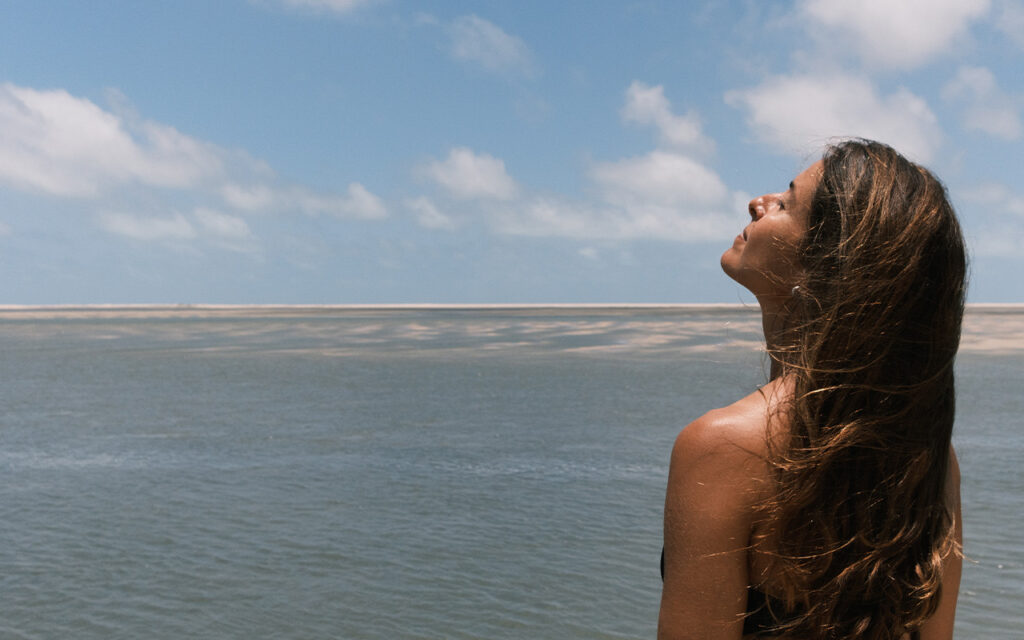
In a world that never stops, real luxury isn’t about what you own — it’s about your ability to silence the world and fully engage with what truly matters. Conscious boredom means embracing stillness, letting go of constant activity, and allowing yourself to be fully present without distractions.
Three days in Atins, and Marina still hadn’t visited the most famous lagoons of Lençóis Maranhenses. Not out of laziness or lack of interest, but because she had discovered something more precious: the freedom of not having to do anything.
Lying in the hammock on the chalet’s veranda, a forgotten book beside her, she watched the buriti leaves sway in the wind. For the first time in years, silence didn’t scare her. There was no schedule, no next commitment, no guilt about being there — simply present, producing nothing but presence.
“I thought I’d go crazy with boredom on the first day,” she would later confess. “I spent my whole life optimizing every minute. The idea of wasting time made me anxious. But here I realized that what I used to call boredom was actually the first time in years that my mind had room to breathe.”
The Paradox of Contemporary Luxury

For decades, the luxury tourism industry operated under a simple premise: the more, the better. More services, more activities, more options. Resorts competed over the size of their experience menus — sunrise yoga classes, guided expeditions, craft workshops, themed dinners, nighttime entertainment. The implicit promise was that the value of a stay could be measured by the number of things you could fit between check-in and check-out.
But something has changed in the way sophisticated travelers understand luxury. Not suddenly, but gradually, through saturation. We live increasingly accelerated lives, fragmented by constant notifications, endless meetings, overlapping deadlines. According to a 2024 Gallup survey, 76% of urban professionals report symptoms of burnout at least once a month. The World Economic Forum identifies digital fatigue as one of the major mental health issues of the decade.
In this context, offering “more of the same” — even in a paradisiacal setting — stops being luxury and becomes an extension of the problem. The contemporary traveler doesn’t want to swap the office’s overstimulation for the resort’s overstimulation. They want the opposite: permission to stop.
“The philosopher Bertrand Russell, in his seminal 1932 essay In Praise of Idleness, already argued that modern civilization had created a dangerous cult of constant work, forgetting that great human advances — artistic, scientific, philosophical — emerged from periods of contemplation, not from frantic productivity.”
True luxury today is not having access to everything, but having permission to do nothing. It’s not about the quantity of experiences, but the quality of presence. Not consuming a place, but allowing yourself to be affected by it — slowly, without haste, without a predetermined script.
The Science of Doing Nothing
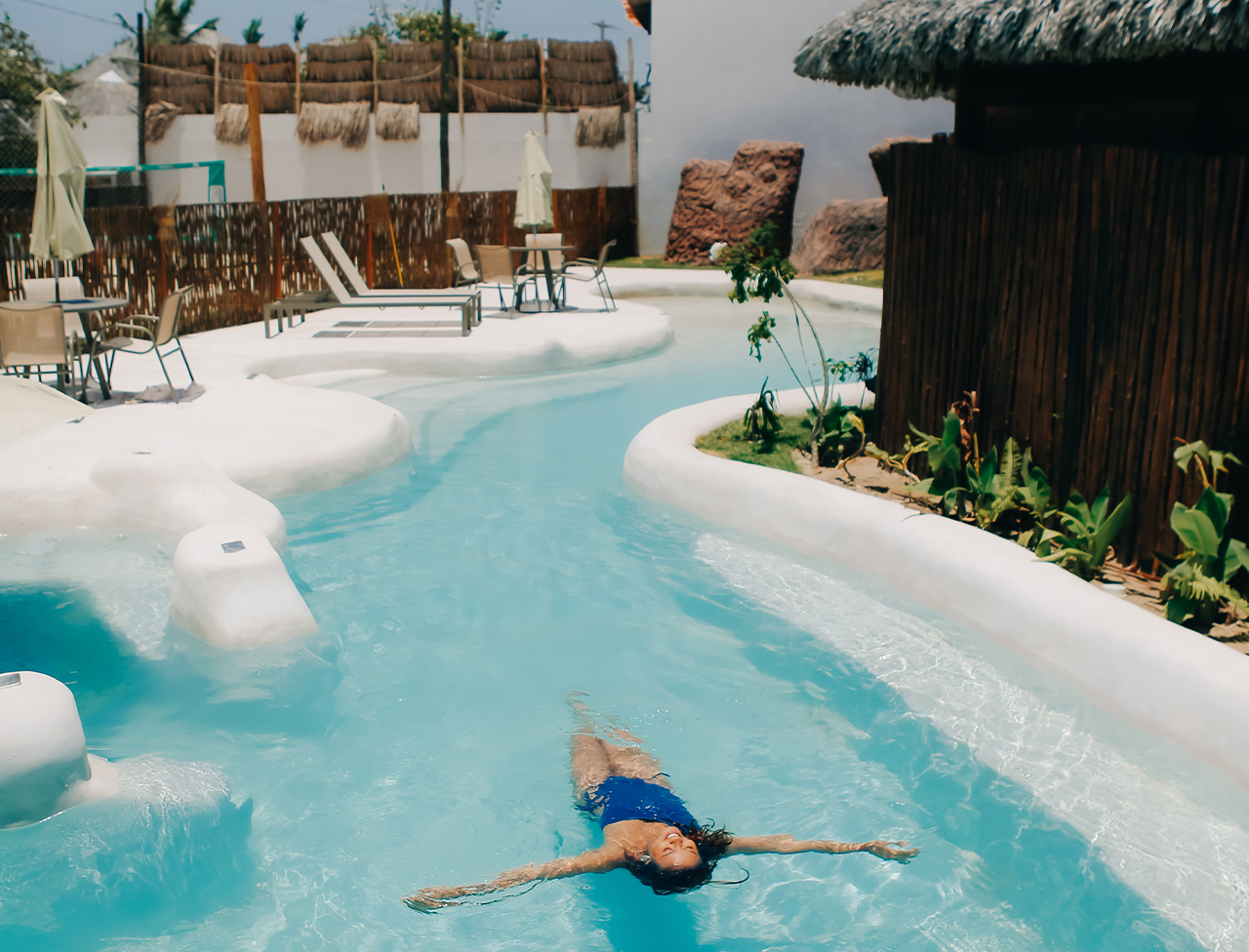
Far from being a waste of time, doing nothing is a necessary condition for fundamental cognitive processes that hyperconnectivity constantly interrupts.
Neuroscientists have identified what they call the default mode network — a network of brain regions that becomes active precisely when we are not engaged in any specific task. During daydreaming, the mind wanders, making unexpected connections between seemingly unrelated ideas. It is in this state that creativity flourishes, solutions to complex problems emerge, memories consolidate, and emotions are processed.
A study from the University of California published in the Journal of Experimental Psychology showed that participants who experienced periods of boredom before creative tasks generated solutions that were 40% more original than those who were kept constantly stimulated. Boredom is not an empty void to be filled, but fertile space where the mind reorganizes information in new ways.
Psychologist Sandi Mann, from the University of Central Lancashire, argues in her book The Science of Boredom that our contemporary intolerance of boredom — immediately filled by scrolling on social media — deprives us of an essential psychological resource. “When we allow the mind to be unoccupied, it doesn’t stop working. On the contrary, it begins operating on deeper layers, processing accumulated experiences and generating insights that constant activity blocks.”
For those living at an accelerated urban pace, vacations that replicate this rhythm — meticulously planned itineraries, every hour filled with a new activity — do not offer genuine rest. They merely offer a change of scenery for the same anxious consumption of experiences.
True rest — the kind that deeply renews — requires the opposite: empty, unfilled time, where the mind can finally slow down until it finds its own natural rhythm.
Charme Atins as a Laboratory for Slowing Down

There is something in the landscape of Lençóis Maranhenses that invites — almost demands — a different pace. The vastness of the dunes, the silence broken only by wind and waves, the light that changes so gradually that we only notice when it has already completely transformed the color of the sky.
Here, you cannot rush the tides. You cannot speed up the sunset. Nature imposes its own timing, and the only choice is to synchronize with it or become frustrated.
The Charme Atins properties were designed precisely to facilitate this synchronization. Not by aesthetic accident, but by clear philosophical intention. The spacious verandas are not just beautiful — they are architectural invitations to contemplation. The hammocks, strategically positioned, capture the best views and breezes, transforming the simple act of lying down into a complete sensory experience.
“I brought three books, thinking I’d devour them all. I read twenty pages of the first one. Not out of disinterest, but because I realized I was more interested in contemplating the dunes of Lençóis.”
— Flávio Duarte, architect from São Luís
The landscape also rewards patient observation. The lagoons of Lençóis change color depending on the angle of the sun. What looks turquoise blue at noon turns into a golden mirror at dusk, then silver under the moonlight. Those who rush to follow an itinerary see one lagoon. Those who stay see ten different lagoons in the same place.
This is precisely the point. Luxury is not about seeing many places, but about truly seeing one place — with a depth that only unhurried time allows.
A Practical Guide
Doing nothing should be easy — after all, it literally means not doing something. But for people conditioned to constant productivity, it’s a skill that needs to be relearned, gently and without judgment.
How to Relearn How to Stop
1. Acknowledge the initial discomfort
In the first moments of silence and lack of stimulation, it’s normal to feel restlessness, even anxiety. Your brain is used to a constant flow of information and will protest when that flow stops. It’s not your failure. It’s a symptom of conditioning that can be undone.
2. Start small
If the idea of spending an entire afternoon doing nothing feels impossible, start with fifteen minutes. Choose a place — a hammock, a chair facing the sea — and simply stay there. No phone, no book, no objectives. Just observe what happens in your mind when it has no specific task.
3. Allow yourself not to finish
Did you bring a stack of books to read? A playlist of educational podcasts to finally listen to? It’s okay if you don’t consume any of it. The pressure to be productive even while resting — to improve yourself, learn something new, optimize time — is exactly the pattern you are here to interrupt.
4. Differentiate presence from anesthesia
There is a difference between conscious non-doing and escapist non-doing. Spending hours scrolling on your phone without attention is not rest; it’s anesthesia. Looking at the horizon, feeling the wind, listening to the sounds around you — even if it seems like you’re “doing” nothing — is active presence. One renews you; the other merely postpones exhaustion.
5. Give time to time
The magic rarely happens on the first day. It usually takes two or three days for the nervous system to finally accept that there is no emergency, nothing urgent, that it’s okay to slow down. Don’t judge the experience prematurely. Trust the process.
What Happens When You Stop
Marina eventually visited the lagoons. On the fourth day, when her body had finally slowed down enough, she woke up with a genuine desire to walk through the dunes. Not out of obligation to “do everything Atins has to offer,” but from an organic desire that emerged from the space created by the previous days of non-doing.
The experience was completely different from what it would have been on the first day. Instead of compulsively taking photos to prove she had been there, she spent long moments simply looking. She noticed details that haste would have erased — animal tracks in the sand, the patterns drawn by the wind on the dunes, a silence so deep that she could hear her own blood pulsing in her temples.
“It was the first time I didn’t feel the need to document everything. I trusted that the memory, the sensation, would be enough. And it was. Weeks later, I remember that walk more clearly than entire trips where I took a thousand photos.”
— Marina Siqueira, São Paulo
This is what non-doing cultivates: the ability to be present. And presence transforms the quality of everything else. Food tastes better. Conversations go deeper. Landscapes affect you more profoundly. Not because these elements have changed, but because you finally have full attention to perceive them.
Luxury is not having extraordinary experiences. Luxury is having the capacity to fully experience whatever is happening. And that capacity only flourishes in the soil of slowed-down time, of permission to do nothing other than be.
In Atins, surrounded by the vastness of Lençóis, by silence punctuated only by natural elements, by architecture that invites rest, you have the ideal conditions for this rare learning: that doing nothing is not a waste, but perhaps the most sophisticated use of time there is.
The invitation is made. Not to do everything, but to have time to do nothing. And to discover that this is everything.
See more articles

REFLECTIONS FROM OUR FOUNDER
Time Passes Differently in Atins - Charme Atins By Anna Teresa Ramus, Co-founder of the Charme Atins Group There is…
7 DAYS RESET IN ATINS
Science confirms that a break of just a few days can already transform body and mind. Discover what happens when…