
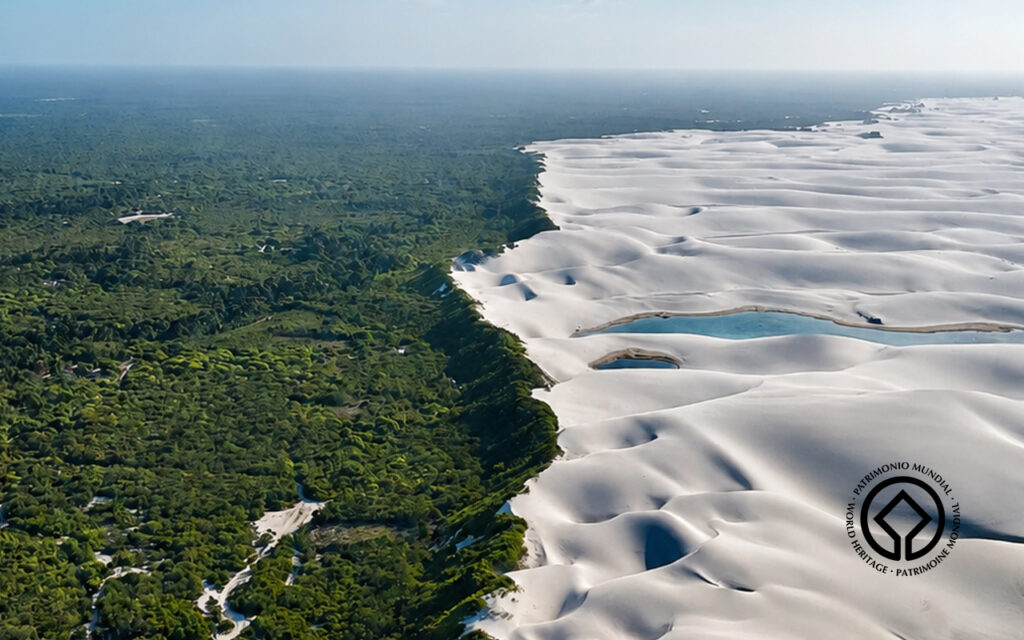
The dunes of Lençóis shift a few meters every year, driven by the same wind that draws kitesurfers. The lagoons are born with the rains of the first half of the year and recede toward the end of the year, taking with them fish whose annual return still intrigues researchers. Nothing here is permanent, and perhaps that is the first lesson the place offers to those who arrive.
Sustainable tourism in Atins is not a seal hanging behind the reception desk. It is a sum of small decisions, made every day, by those who live here and those who come to visit. Lençóis Maranhenses National Park spans 155,000 hectares and has a carrying capacity that no one should put to the test.
This article brings together what Grupo Charme Atins does, what the legislation requires, and what rests on the traveler, because all three only work together.

In July 2024, Lençóis Maranhenses was designated a UNESCO Natural World Heritage site. The recognition does not merely celebrate the landscape’s beauty; it honors a rare system: a coastal dune field that fills with roughly 66,000 freshwater lagoons, set in a transition zone between the Cerrado, Caatinga, and Amazon biomes.
A title like this brings visibility, and visibility brings people. That is the delicate side of the story. The lagoons are closed, seasonal ecosystems with no current to dilute whatever enters them. The dunes are reshaped by the wind, but the restinga vegetation that anchors them takes years to recover once trampled. The landscape appears resilient from afar, but is fragile up close.
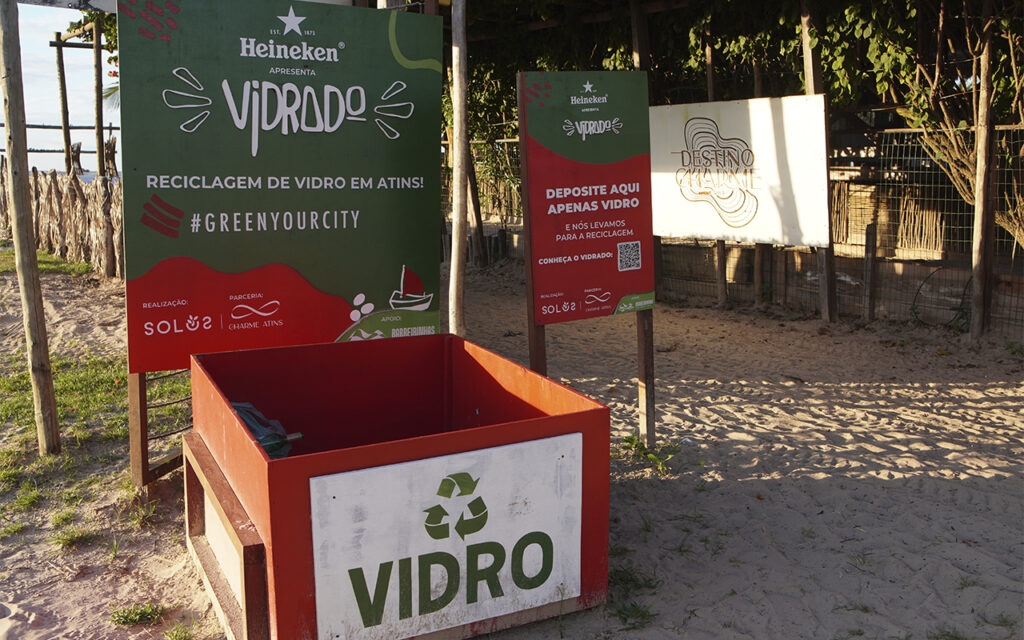
Being at the gateway to the Lençóis Maranhenses is a privilege that comes with a commitment. It is from this principle that our partnership with Heineken and the startup SOLOS in Vidrado was born, an initiative that ensures the correct disposal of glass in the village. The project began in Caraíva in 2020 and arrives in Atins after five years of transforming a paradise’s relationship with what it consumes. To give you an idea of its impact: 154 tons of glass have been collected, returning to the world as 810,000 new bottles. Glass is infinitely recyclable. Every proper disposal saves energy, water, and raw materials, and keeping it in circulation is one of the most beautiful ways to honor the landscape that welcomes us.
Em Atins, isso acontece pé na areia, no ritmo do lugar. Pontos de coleta espalhados pelo vilarejo, um veículo dedicado que percorre as vias de areia, uma central de triagem e um time local que faz o vidro chegar até a reciclagem sem desvios. Priorizamos fornecedores da região e capacitamos equipes da própria Atins, porque hospitalidade de verdade também é aquela que gera pertencimento.
Aqui, todo mundo é vidrado no descarte correto. Cada garrafa tem um destino. Nós cuidamos do caminho.em parece resistente de longe e é frágil de perto.
Traffic inside the park is restricted to operators accredited by ICMBio, featuring authorized fleets and guides. This is not red tape: it is the mechanism that regulates how many vehicles enter, where they drive, and at what times. Private circuits for one to six people exist for this reason as well—to reduce the number of cars traveling over the sand.
Avoid entering the water with freshly applied sunscreen or insect repellent. The water is still and does not dilute anything. Apply well before arrival or opt for physical sun protection like a shirt and hat.
Walk only along the path indicated by your guide and keep your distance from the restinga coastal vegetation. Everything brought in leaves with you, including organic waste. Sand and shells stay where they are.
Keep speeds low on the sandy streets, where children, horses, and pedestrians move about. Respect quiet hours after 10:00 PM. And always ask for permission before photographing local residents.
None of these rules ruin a trip. Together, accumulated across an entire visitor season, they determine the state in which the park arrives the following year.
There is a possible version of Atins with hotel chains, paved streets, and tour buses driving all the way down to the beach. It would be more profitable in the short term, but it would destroy the very thing that makes someone cross the country to get here.
Grupo Charme Atins exists to prove that the other version is viable: high-end comfort in a village with sandy streets, driven by a local team, local suppliers, and a small scale. Sophistication, here, is the discipline of not overbuilding. To learn more about our commitments in detail, visit our sustainability page or read more about Grupo Charme Atins.
Our Charme Concierge organizes itineraries with accredited operators, at the scale and in the month that the park can best sustain.
Speak with our team on WhatsAppSee more articles
Lençois Maranhenses National Park You reach Atins by water or by sand, never by asphalt. Perhaps that is why the…

Almost everyone returns from Lençóis with the same feeling: the photos don't do it justice. The sand comes out too…